

The Numbers Say Uncertainty. DMVers Say Forward.
Six months ago, uncertainty filled the room. But so did our intent to change that dynamic.
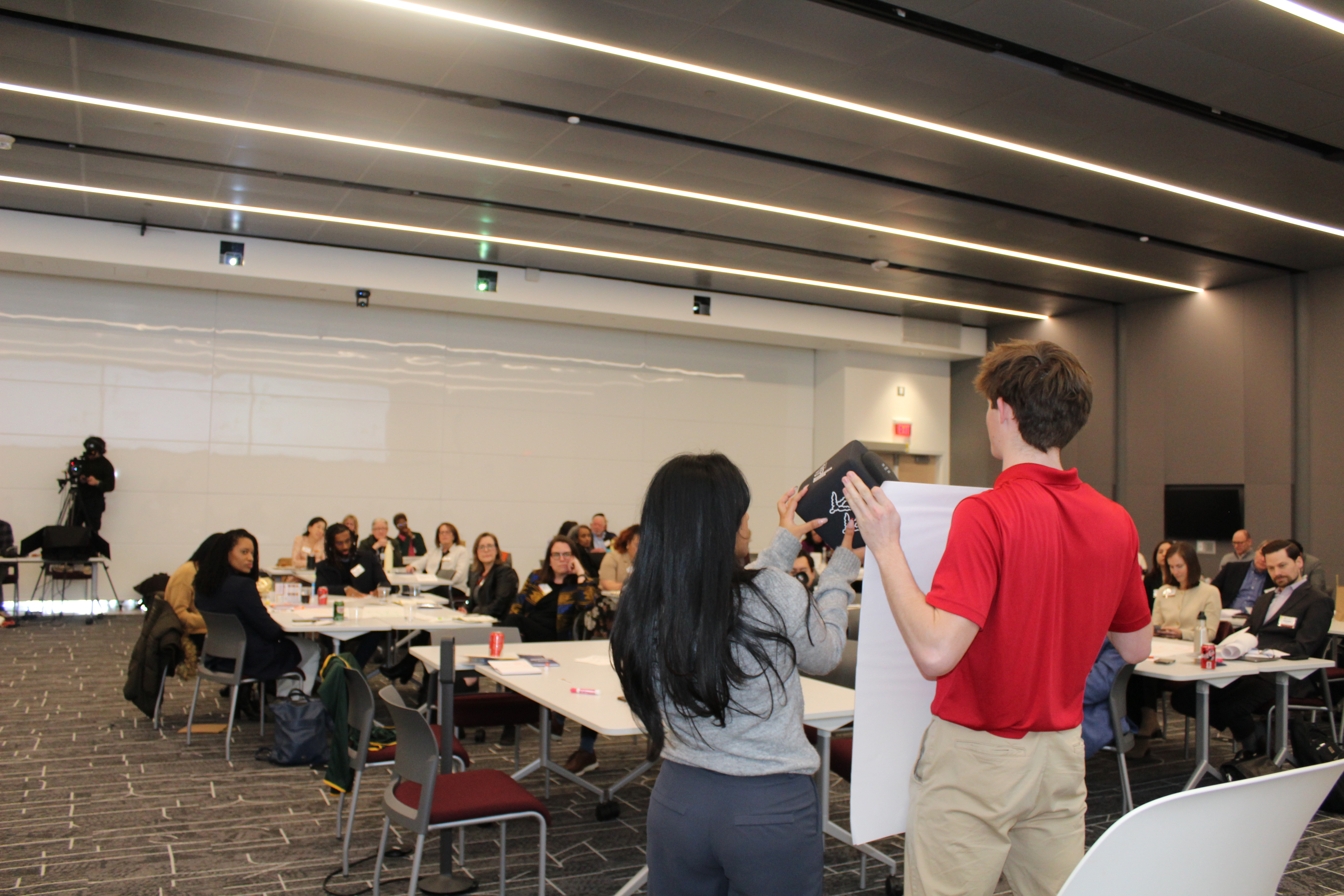
We convened ForwardDMV at Virginia Tech’s Boeing Center to explore two challenges reshaping our region: a contracting federal government and AI’s growing impact on early-career pathways. Bringing the DMV’s thinkers and doers together was no small feat. More importantly, it proved that difficult moments can inspire uncommon, and potentially game-changing, collaboration.
Now, in the 25th edition of the ForwardDMV newsletter, we want to hear from you. Looking back, are you hopeful, ready to start wearing your shades, or do you feel like we’re bullriding a downbound train? And what do you expect from the next six months?
From Kaptivate’s vantage point, the statistics tell a mixed story. Our winter concerns proved well-founded. Burning Glass Institute Chief Economist Gad Levanon has documented the sharp deterioration of early-career opportunities for recent college graduates. That sobering picture has been reinforced by record restaurant closures and an office market still struggling to regain its footing.
But that is not the whole story.
Alexandria and Arlington are collaborating on a new innovation district. Prince William County is strengthening its own innovation ecosystem. Virginia and Maryland are attracting major investments in life sciences, quantum computing, AI, and other emerging technologies. Baltimore could be the center for drone shipbuilding.
A mixed bag? Absolutely. Yet in the Year of the Fire Horse, the DMV is showing both its resilience and a little fire-breathing prowess.
The region’s real strength, however, is not captured in a data set. It lives in its talent. More precisely, the people and organizations working to cultivate that talent.
Our optimism is not delusional. We know the road ahead will be rocky. But we do not see the region’s residents packing up en masse for greener pastures. We see people taking a stand, reinventing themselves, and building what comes next.
Weeks after ForwardDMV, Kaptivate and FHI 360, for example, hosted an Innovation Lab that launched a regional community focused on scaling internships, apprenticeships, and other early-career opportunities. It was spurred by our conversation at the Boeing Center but the candid, productive, and powerful Innovation Lab launched a community of action.
We also convened organizations working to help former federal employees navigate gig assignments, bridge opportunities, and entirely new career paths. Problem-solving organizations such as WellFed, GovBench, and others came together to help highly skilled people imagine new possibilities, take calculated risks, and reinvent themselves. For many, a once anxiety-inducing gig economy is beginning to look more like a bridge to greater autonomy.
Perhaps the most compelling evidence of the DMV’s resilience is the work underway to build its future talent pipeline.
We initially looked to policymakers to take the talent baton and run. Instead, we found that educators are leading the first leg of the race. Many of these heroes have always worked in K–12 schools. Increasingly, however, we are encountering higher-education leaders who are attracting commercial and federal investment in emerging technologies while extending those opportunities deeper into the talent pipeline.
At Virginia Tech, Professors Lingjia Liu and Yang “Cindy” Yi are among the scientists leading the Brain-Inspired Computing, Communication, and Security Lab, advancing work in neuromorphic computing and next-generation wireless technology. At George Mason University, Dr. Patrick Vora is helping build a powerful nucleus for quantum research, education, and experimentation with programs reaching into local K–12 schools. Michael Tadesse at George Washington University and George Mason Chief AI Officer Amarda Shehu are championing the possibilities of an AI-driven future. In Maryland, University of Maryland researchers Jing Liu and Wei Ai are connecting AI innovation directly to K–12 math instruction and teacher development.
What impressed us most was their determination to make emerging technologies accessible and practical. This outreach extends far beyond their college students, to cohorts of children in elementary, middle, and high school. They are thinking beyond the next semester, grant, or publication. They are thinking generationally.
So, how do we assess the past six months?
The statistics say uncertainty. Our experiences (and our regional partners) tell us something more hopeful. They reveal a fire-breathing DMV beginning to imagine a future beyond an increasingly constrained federal patron. This is a region thinking long term, investing now, and refusing to simply wait for better days.
What will the next six months bring? Hard to say. But after encountering this much energy, resilience, and determination, it is hard not to be optimistic.
It has only strengthened our commitment to help the region Shape What’s NextTM.
.jpg)