

Why connectivity may be the most overlooked solution to America's mental health crisis
The United States does not have enough mental health providers to meet demand. That is not a new insight. What is new is how that care is being delivered and what is standing in the way of scaling it.
For decades, access to care has depended on geography and access to increasingly full patient panels. If you lived near providers, you might have options. If you didn’t, you waited, or went without care entirely. This supply constraint is beginning to shift with the emergence of telehealth for mental health therapy. The shift is not theoretical. It is already happening at scale.
Now the real question is not whether virtual mental health care works. It is whether people can access it.
The market has already moved
Over the past several years, a new generation of mental health providers has emerged. These new provider platforms are built from the ground up for virtual care.
Companies like Talkiatry, Grow Therapy, Alma, Brightside Health, and InStride Health are building national networks that connect patients to licensed providers, often covered by insurance. These are not small pilots. They are operating at scale:
- Talkiatry has delivered more than 3 million virtual visits and operates across 45 states, backed by a $210 million funding round to expand access
- Grow Therapy connects patients to a network of more than 25,000 providers
- Alma has raised more than $220 million to streamline insurance and telehealth delivery (“Topic #1: Talkiatry,” 2026)
This level of investment is not speculative. It reflects a clear signal: Demand for mental health care is real, and virtual delivery is a viable way to meet it. Investment is following patient flows.
According to the 2024 Doximity State of Telemedicine Report, 96% of patients who used telemedicine said it provided care that was equal to or better than in-person visits, and 82% said it helped them stay on track with treatment. (State of Telemedicine Report, 2024)
“...mental health conditions account for roughly two-thirds of all telehealth claims nationwide…”
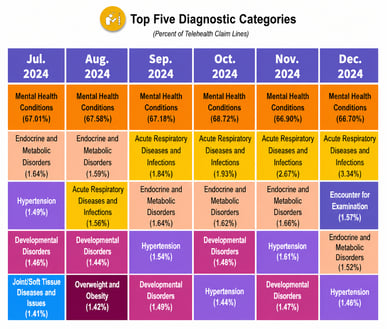
Mental health is driving this market movement. FAIR Health data shows that mental health conditions account for roughly two-thirds of all telehealth claims nationwide, making it the single largest use case (FAIR Health Launches Telehealth Tracker Trending Reports, Revealing Trends Over First Six Months of 2024, 2024). A solution to our mental health care scarcity has surfaced but it now depends on the expansion of broadband infrastructure.
But connectivity’s link to the telehealth use case lags
Even as virtual care expands, access to it is uneven. The same populations that face the greatest shortages of mental health providers (rural communities and low-income households) are also the least likely to have reliable broadband access. More than 28 million U.S. households still lack high-speed internet, and for many of them, the issue is not infrastructure (Brattle Group et al., 2025). It’s awareness. Awareness of the transformative power broadband connectivity can have on their lives.
Research is beginning to show this clearly. A recent study found that patients in less disadvantaged areas were significantly more likely to use telehealth for mental healthcare than those in more disadvantaged communities, despite similar levels of need (Ettman et al., 2025). The issue may not be whether they’ve been connected but rather that they don’t know, or don’t yet appreciate, the use case.
Broadband is now part of the healthcare system
This is where the conversation pivots. Broadband is often discussed as infrastructure for economic growth, education, or innovation. All of that is true. But it is now something else as well: Broadband is healthcare infrastructure. Without it, the modern mental health system cannot scale to meet the needs of all communities.
“...Affordable Connectivity Program (ACP) enabled roughly 12 million additional telehealth visits per year, generating $28.9 to $29.5 billion in annual healthcare savings—more than four times the program’s cost.”
The economic case is just as strong as the clinical one. A recent analysis from The Brattle Group found that expanding broadband access through the Affordable Connectivity Program (ACP) enabled roughly 12 million additional telehealth visits per year, generating $28.9 to $29.5 billion in annual healthcare savings—more than four times the program’s cost (Brattle Group et al., 2025).
A single telehealth visit for a Medicaid patient can generate enough savings to cover 3.5 years of broadband support.Those savings come from simple, practical changes:
- fewer missed appointments
- less travel time and cost
- earlier intervention
- reduced strain on emergency care (Brattle Group et al., 2025).
Mental health care is especially well suited to these gains. It does not require physical exams or equipment. It requires conversation, continuity, and access to a licensed provider. Broadband enables all three.
Not a call for chat-bot mental therapy. It’s access to professional care.
There is a growing conversation about AI and chatbot-based mental health tools. Those tools may play a role in the future. But they are not the focus here.
The opportunity that investors are pouring cash into is connecting underserved patients and communities to licensed therapists and psychiatrists. It’s taking a scarce resource and providing new access to it virtually. It’s the realization of broadband infrastructure’s promise to improve the quality of life, and future, for all Americans. And it’s happening today. Patients are already using it. Insurers are already paying for it. If we can build awareness, and disseminate education, we can capture the easiest of wins for our national broadband infrastructure investment. Commercial investors see the opportunity now federal and state policymakers and planners need to grab the low hanging fruit.
BEAD Non-deployment funds can move the dial
The United States is in the middle of the largest broadband investment in its history through the BEAD program. The goal is simple: connect every American to high-speed internet. With most state plans approved and deployment about to begin, we need to reframe our vision of this generational investment. If we only see broadband as economic infrastructure, we will miss a major part of its value. If it is treated also as health infrastructure, then priorities can evolve. We can see it as more than a capital project. We should see it as an opportunity to improve lives, boost American productivity, reduce federal and state healthcare spending, and launch extraordinary innovation in how we support virtual mental health.
This is not about building something new. It is about connecting systems that already exist. It’s about using some portion of the $21 billion in non-deployment funds to raise awareness, educate communities on this use case, and catalyzing more public-private collaborations to expand and innovate on how we use telehealth to deliver mental healthcare.
Take the wins
“Building awareness of telehealth-delivered, mental healthcare is a spectacular opportunity to use a portion of appropriated BEAD funds to drive innovation, solve for scarcity, and unlock the potential of many underserved communities.”
The future of mental health care is already being built. It is virtual. It is networked. It is no longer limited by geography. But it is still limited by awareness.
Broadband will not solve the mental health crisis on its own. There will still be shortages. There will still be gaps. But without broadband, many communities will remain locked out of the solutions that are already working.
We have a chance to extend care further, lower costs, and reach people who have long been out of reach. Building awareness of virtual mental healthcare is a spectacular opportunity to use a portion of appropriated BEAD funds to drive innovation, solve for scarcity, and unlock the potential of many underserved communities.
💡 If you’re interested in tracking telehealth (and virtual mental healthcare) delivery as a trend in your state or region, I found the FairHealth Monthly Telehealth Regional Tracker to be an insightful resource.
References
Brattle Group, Brattle Group, & Brattle Group. (2025, February 19). New Brattle Study Finds the Affordable Connectivity Program Pays for Itself [In a 2025 report, experts from The Brattle Group provide an economic analysis of the Affordable Connectivity Program (ACP) – which offered monthly broadband service subsidies to low-income households – and find that the economic benefits gene]. New Brattle Study Finds the Affordable Connectivity Program Pays for Itself. https://www.brattle.com/insights-events/publications/new-brattle-study-finds-the-affordable-connectivity-program-pays-for-itself/
Ettman, C., Ringlein, G., & Dohlman, P. (2025, February 7). Trends in mental health care and telehealth use across area deprivation: An analysis of electronic health records from 2016 to 2024. Trends in mental health care and telehealth use across area deprivation: An analysis of electronic health records from 2016 to 2024, 4(2), pgaf016. https://academic.oup.com/pnasnexus/article/4/2/pgaf016/8003900
FAIR Health Launches Telehealth Tracker Trending Reports, Revealing Trends over First Six Months of 2024. (2024, November 21). FAIR Health Access. https://www.fairhealth.org/article/fair-health-launches-telehealth-tracker-trending-reports-revealing-trends-over-first-six-months-of-2024
State of Telemedicine Report. (2024, October 21). State of Telemedicine Report 2024. https://www.doximity.com/reports/state-of-telemedicine-report/2024
Tallkiatry. (2026, April 21). In Exploding Topics Newsletter (email). Semresh. https://tools.explodingtopics.com/keyword?q=Talkiatry&db=us&utm_source=et-basic&utm_medium=email&utm_campaign=et-basic-21-apr-26