
Same investment. Five different bets on how to make it work.
Four Historically Black Collages and Universities (HBCUs) and one Predominantly Black Institution (PBI) received federal broadband funding. Each faced different terrain: different communities, different levels of trust, different local economies. So each built something different. This is what they built, and what happened.
Section 01: Background
The problem, the federal response, and what this study set out to answer
To understand what these five institutions accomplished, it helps to start with why the investment existed at all, and what questions researchers were trying to answer.
To answer this, researchers used an economic modeling tool that traces how grant spending ripples through local economies, tracking the jobs created, wages paid, and revenue generated in each host county.
To answer this, researchers conducted detailed case studies of each school, interviewing partners, reviewing program records, and documenting the specific choices each institution made about how to deploy the funding in its community.
Across five institutions, four states, and $14.2 million in federal investment, one finding cuts through everything: the same budget, deployed by schools that truly knew their communities, produced wildly different outcomes depending on who was in charge and how freely they could act. That's not a footnote; it's the whole story. Everything on this page is evidence of it.
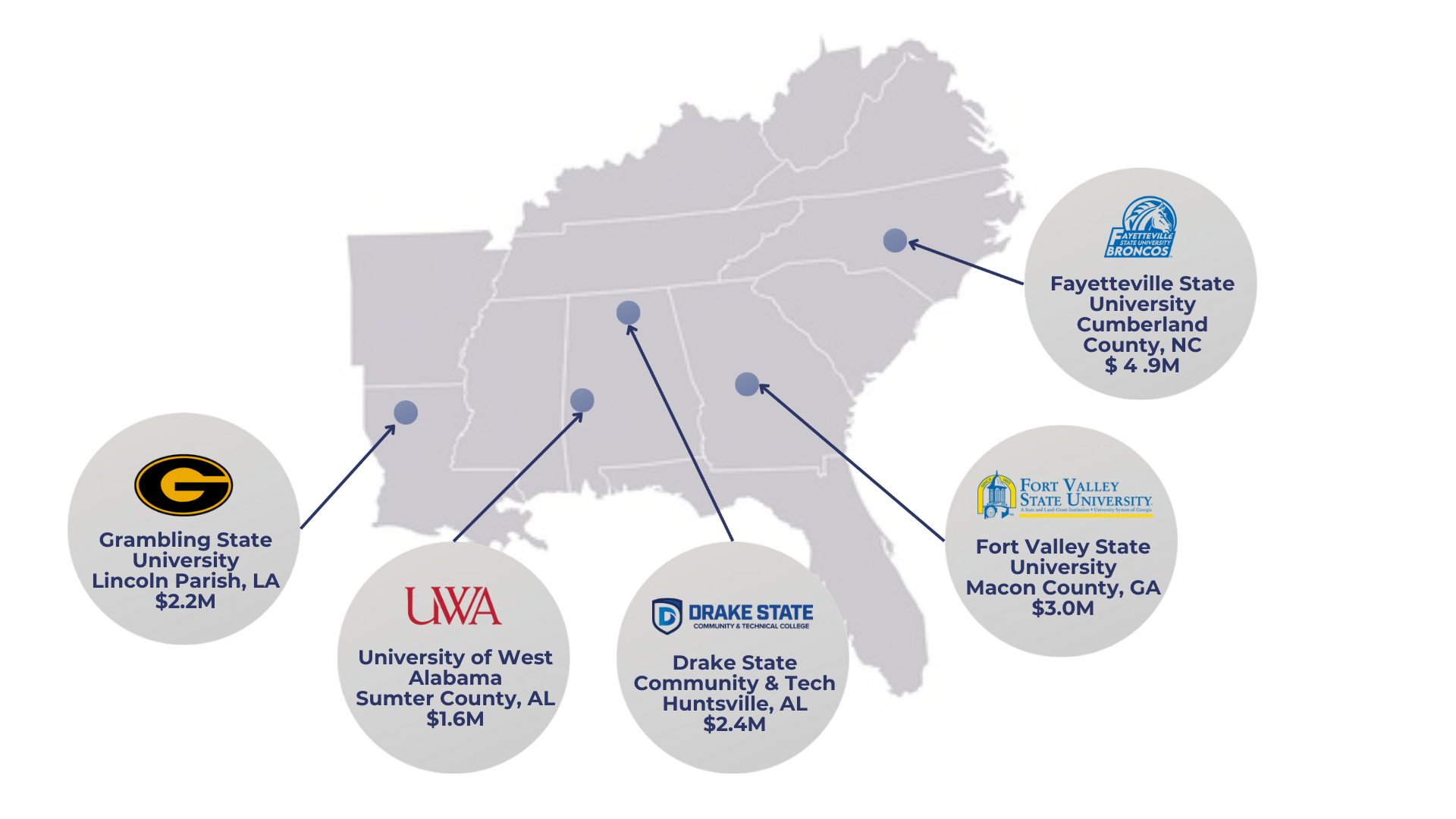
From the pine forests of North Louisiana to the Sandhills of North Carolina, each institution reflects a distinct geographic and cultural landscape, where broadband investments are not one-size-fits-all solutions but locally tailored strategies shaped by community identity.
Section 02 - The Central Finding
The same budget categories. Completely different choices.
Across all five sites, we found the same underlying logic model at work: local context shaping decisions about infrastructure delivery, adoption strategy, and economic pathway, and those decisions galvanizing regional impacts. That structure is our central finding because it explains not just what happened, but why it wouldn’t have worked any other way.
The technical approach varied dramatically based on what each community actually looked like. One school sent a mobile lab into neighborhoods on wheels. Another activated fixed hubs at places people already trusted. A third turned to satellite, the only option that could realistically reach Alabama's most remote corners.
Getting wires in the ground is the easy part. Getting people to trust the technology, and the institution behind it, is where most programs fail. Each school tackled this differently: student navigators visiting homes directly, co-governance summits that gave residents a seat at the table, and community events that made digital tools feel local, not imported.
The same connectivity can lead to very different economic benefits depending on what the surrounding community actually needs. Each school identified a different local opportunity and aimed at it: from fast-track cybersecurity jobs in Huntsville, to defense supply chain access in Fayetteville, to blended health and workforce pathways in the deep rural South.
What it looked like in practice
Connectivity on its own is just a start. What matters is the scaffolding built around it - the trust, the training, the local knowledge - that turns a network into something people can actually use to change their lives.
Section 03: The Five Institutions
Five schools. Five communities. Five approaches.
Each HBCU sits in a community long on the wrong side of the digital divide. What they built with CMC funding reflects a deep understanding of what their neighbors actually needed. Click on the "Explore more" tab for any institution to see its full case study.
Explore more: How Drake State took the classroom to their community.
Explore more: How Fort Valley built trust alongside bandwidth.
Explore more: How Fayetteville helped local businesses compete for billion-dollar defense contracts.
Explore more: How Grambling State integrated digital skills across their commnunity.
Explore more: How UWA evolved its infrastructure to overcome its geography.
Huntsville isn't a struggling town. It's a booming aerospace and defense hub: Redstone Arsenal, NASA's Marshall Space Flight Center, hundreds of high-tech contractors hiring faster than they can fill positions. But Drake State's students lived in the shadow of that boom. Low-income neighborhoods minutes from aerospace campuses had weak broadband, limited device access, and zero connection to the cybersecurity jobs right next door.
Drake's insight: The gap wasn't geography. It was visibility. People didn't know the pathway existed, and even if they did, they couldn't afford to wait years for a four-year degree to access it.
Drake didn't build a recruiting campaign. It built a vehicle, literally. The Mobile Cyber-Lab was a fully equipped digital classroom on wheels, outfitted with LTE connectivity, laptops, and trained instructors. It rolled into housing developments, community centers, and neighborhoods that had never seen a college recruiter, let alone a cybersecurity training program.
Drake restructured its cybersecurity program with Western Governors University to offer modular digital badges and micro-credentials. Students could earn recognition at multiple checkpoints, with no need to finish an entire degree before something showed up on a résumé. Someone working two jobs can't afford to invest two years before seeing a return. Drake made it possible to upskill in six-week bursts, land a better-paying job, then return to earn the next credential on their own schedule. WGU's articulation agreements meant those credits stacked toward a bachelor's degree, with no waste and no dead ends.
Via Kajeet, Drake distributed LTE-enabled laptops and hotspots to Pell-eligible students: not just hardware, but a structured on-ramp with technical help and instructional embedding built in. The device was the key, but Drake built the door.
Execution was fast by design. Hardware procurement, device distribution, and partnership coordination were all fast-tracked through collaboration with Howard Tech Industries and Alabama A&M. Most infrastructure investments take years to show economic impact because of lag effects. Drake collapsed that lag, producing observable outcomes within the grant cycle.
Most rural broadband initiatives face the challenge of creating economic opportunity where none exists. Drake faced the opposite: opportunity was everywhere, but invisible to the people who needed it most. The mobile lab made the pathway visible. The stackable credentials made it affordable. The device program made it sustainable. And the speed of execution meant students didn't have to wait years to see results.
Macon County, Georgia: 25.5% poverty rate, $37K median income, surrounded by peach orchards and farmland. Fort Valley State has been there for over a century. But residents had seen plenty of "community programs" come and go, with outside consultants promising transformation, delivering nothing, then leaving. The technical problem wasn't the hardest part. The trust problem was.
Fort Valley's wager: Don't deliver to the community. Build with the community. Make them co-owners, not beneficiaries.
Most institutions treat community input as a box to check. Fort Valley turned it into the operating system. Quarterly summits brought together faculty, students, local officials, business owners, and residents, not to rubber-stamp university decisions, but to make the decisions. Priorities, program design, rollout timelines, and success metrics were all shaped collaboratively.
- Residents identified which community anchors (senior center, library, and youth center) should get hubs first, based on where people already showed up
- Local business leaders flagged which workforce skills mattered most for regional hiring, shaping the micro-credential offerings
- County officials navigated permitting and right-of-way for fiber deployment, acting as partners rather than obstacles
- Students and faculty adjusted program delivery based on what was working on the ground, not what looked good in the grant proposal
This wasn't consultation theater. It was shared power, and it changed everything.
Broadband hubs went into the senior center, Peach Public Library, and youth center, places residents already trusted, turning them into digital commons with telehealth kiosks, 24/7 Wi-Fi, and digital literacy workshops led by staff who already had community credibility. Working with the Georgia Public Service Commission and Urban Research, Fort Valley also installed miles of new fiber-optic cable designed not just to upgrade the campus network, but to create outward-facing capacity for households, farms, and public sites across Macon County. The infrastructure wasn't the university's. It was the region's.
Fort Valley launched micro-credentials in cybersecurity, agricultural technology, and digital communications: short-format, hybrid, and asynchronous. Designed for working adults who couldn't quit their jobs to go back to school full-time. Partnership with Georgia College & State University meant credits were transferable and students had a clear pathway to continue building.
Via Macon County Headstart, Fort Valley distributed laptops, hotspots, and signal boosters to families in early literacy programs, with digital skills training from trusted program staff embedded in the distribution. Parents weren't just getting hardware; they were getting a support system that made it actually useful.
In places that have been over-promised and under-delivered to for decades, process is outcome. Fort Valley didn't just build broadband infrastructure; it built civic infrastructure. The quarterly summits weren't a nice-to-have; they were the mechanism that turned skeptics into advocates and outsiders into co-owners. When people help design a program, they have a stake in making it work. And when the hubs went into places they already trusted, broadband wasn't foreign technology. It was an upgrade to somewhere they already belonged.
Cumberland County, North Carolina, home to Fort Bragg, one of the largest military installations in the world. Defense contractors everywhere. Supply chain opportunities up and down the corridor. And yet: small businesses in Fayetteville's surrounding communities couldn't compete for those contracts. Not because they lacked capability, but because they lacked cybersecurity certification, digital infrastructure, and e-commerce readiness.
Fayetteville State's realization: The gap wasn't skills. It was visibility and validation. Local firms needed someone to audit their systems, get them contract-ready, and connect them to the buyers next door.
FSU built a campus facility where faculty-led teams, supported by the Mary S. Peake Fellowship, a nonprofit focused on upskilling HBCU scholars, conducted free cybersecurity audits for small manufacturers and tech businesses. Not generic advice. Actual penetration testing, vulnerability assessments, and compliance gap analysis against DoD standards.
- Security posture assessment
- Roadmap to DoD compliance standards
- Digital marketing strategy review
- E-commerce platform setup guidance
- Real-world client experience
- Portfolio-worthy projects
- Market-relevant skill development
- Direct exposure to defense sector work
The national security angle was real: many of these businesses participated in the fifth tier of the defense industrial supply chain. Cybersecurity vulnerabilities at this tier have been exploited by adversaries. FSU's audits didn't just help local firms compete; they hardened a strategic vulnerability in U.S. defense infrastructure.
FSU trained student interns to serve as Anchor Community Navigators, digital troubleshooters who went to people's homes and businesses to solve connectivity problems, set up devices, and teach digital skills one-on-one. Infrastructure alone doesn't drive adoption. Someone has to translate the technology into practice. The navigators lowered the psychological barrier ("I'm not a tech person") as much as the logistical one.
FSU also distributed laptops through a loaner program and expanded outdoor Wi-Fi across campus commons so students could work from benches, parking lots, or green spaces without being tethered to a lab or limited by building hours. This is what seamless access actually means: you can move between home, campus, and public spaces without your connection dropping.
FSU incorporated virtual reality simulations into business and technical coursework, where students practiced pitch meetings, navigated supply chain disruptions, and troubleshot manufacturing problems in immersive environments. Faster skill development, lower time-to-degree, more job-ready graduates. The VR lab wasn't a gimmick; it was an acceleration tool.
The Mary S. Peake Fellowship partnership wasn't just about funding; it was about creating a talent pipeline model that other HBCUs could adopt. As this model gains traction among peer institutions, it signals a broader alignment of broadband expansion, economic development, and national security rooted in institutions historically positioned to serve both community and country.
Most broadband initiatives focus on consumption, getting people online so they can access services. Fayetteville focused on production: getting businesses contract-ready so they could compete for revenue sitting right next door. The university didn't just close a digital divide. It activated a regional economy by turning latent capability into market-ready capacity. And because the work touched the defense supply chain, the impact rippled beyond Cumberland County into national resilience.
Lincoln Parish, Louisiana: 30.7% poverty rate, the highest of all five case study sites. Median income $38K. Students commuting from remote family farms. And the nearest specialist? A drive most residents couldn't afford to make regularly. The digital divide wasn't abstract here; it was life-or-death. No telehealth meant no preventive care. No broadband meant no telehealth.
Grambling's strategy: Don't just connect people to the internet. Connect them to care. And train the workforce that can deliver it.
Grambling partnered with the Telehealth Certification Institute and equipment provider Mergent to embed tele-counseling modules into the nursing curriculum. Students learned to deliver remote care (virtual therapy sessions, chronic disease management, and post-op check-ins) through actual clinical simulations with real protocols.
This is what closing a health infrastructure gap looks like: train the workforce, deploy the technology, and make the service accessible. Grambling did all three simultaneously.
Unlike most schools that treat cybersecurity as a standalone major, Grambling embedded it across the curriculum. Business majors learned secure data handling. Education majors learned digital ethics. Agriculture students learned network defense basics. Every graduate left with foundational digital security competencies. In a region where small businesses, nonprofits, school districts, and county offices have no dedicated IT security staff, that cross-major pipeline doesn't just build individual skills; it hardens an entire region's digital infrastructure.
Grambling also extended the cybersecurity training to area high school students through a summer bridge program, giving them early exposure to digital careers and proving that pathways into technology didn't require moving to a city. Some of those students are now Grambling undergrads in the cybersecurity track. Partnering with Triumph, Grambling installed exterior Wi-Fi access points and launched an AT&T hotspot lending program, giving rural students commuting from family farms portable connectivity that worked anywhere, making college completable for students who otherwise would have dropped out.
Tech fairs, community workshops, and regular parish meetings where residents, officials, and university staff collaboratively shaped the program. Grambling didn't position itself as a broadband provider; it positioned itself as a trusted convener. The trust built in these settings increased adoption and created shared ownership of the digital ecosystem. Broadband wasn't something the university did to the community; it was something they built together.
Grambling didn't hoard its learnings. Parish officials and peer HBCUs were invited to observe, adapt, and replicate the program. The university documented processes, opened doors to other institutions, and engaged with parish leadership as equal partners, positioning itself as a testbed, not a silo.
In places where healthcare shortages and transportation challenges limit access to basic services, telehealth isn't a luxury; it's infrastructure. Grambling built both sides of the care equation: trained the workforce to deliver virtual care, and gave residents the connectivity to receive it. The cross-curricular cybersecurity embedding ensured that every sector of the regional economy would have digitally literate employees. And the parish-scale engagement model turned broadband from a university project into a community asset, reinforcing Grambling's role as both an economic and social anchor in northern Louisiana's parishes.
Sumter County, Alabama. Population: 12,345. Poverty rate: 28.1%. Median income: $37,981. Cotton fields, cattle pastures, communities scattered across terrain where running fiber is economically unviable and DSL doesn't exist. The digital divide here wasn't a gap; it was a void. And waiting for fiber meant waiting forever.
UWA's realization: Conventional broadband deployment won't work here. So don't try. Build a different model, one that works with the geography, not against it.
UWA didn't wait for fiber that was never coming. Working with county partners to navigate right-of-way approvals and permitting, the university deployed Starlink satellite terminals at town halls, libraries, and community centers across Sumter and Greene Counties, not as a stopgap, but as the primary strategy.
- Population density economics don't work: communities too dispersed for fiber ROI, so ISPs won't invest
- Topography hostile to cable: wetlands, property lines, and legacy ag infrastructure make trenching impractical
- Timeline urgency: residents need connectivity now, not in 5–10 years if fiber ever arrives
- Proven reliability: Starlink delivers broadband-grade speeds in rural deployments, so this wasn't experimental
The satellite-first strategy wasn't settling. It was the only viable path forward. By embracing that reality rather than waiting for fiber that might never come, UWA delivered connectivity on a timeline that mattered to the people who needed it most.
In collaboration with local municipalities, UWA installed outdoor Wi-Fi radios at town halls, libraries, and community centers, creating always-on public access hubs available to students, families, and job seekers long after business hours. In the town of Boligee (population ~400), these access points transformed formerly underutilized public spaces into gathering places. People came for the Wi-Fi and stayed because it became somewhere to see neighbors, get help with devices, and ask questions.
UWA also distributed customized broadband access kits (tablets, laptops, and mobile Zoom carts) to households across the region. The kits were piloted in Panola, a rural hamlet where residents co-designed the usability features with university staff. Device setup flows, tutorial content, and support contact methods were all tested and refined based on actual user feedback. Technology fits into people's lives culturally and practically, not just technically. The kits worked because residents helped design how they worked.
UWA deployed a mobile support van that traveled to households across Sumter and Greene Counties providing one-on-one technical assistance: not a help desk to call, not a tutorial video, but an actual person showing up at your door to troubleshoot a router, set up email, or teach someone how to video call their grandkids. This is what "meeting people where they are" actually means.
With support from nursing faculty and Greene County extension agents, UWA also deployed telehealth technologies that expanded access to therapy, preventive care, and specialist consultations, particularly valuable for elderly and mobility-limited residents who previously had to travel significant distances for basic care. Nursing students gained hands-on experience with telehealth platforms while community members gained access to care they couldn't otherwise reach. Training and service delivery happened simultaneously.
UWA treated exclusion as a design challenge, not a fixed condition. Satellite internet where fiber won't reach. Outdoor Wi-Fi turning public spaces into digital commons. Co-designed device kits ensuring cultural and practical fit. A roving support van meeting people at their homes. Telehealth closing health infrastructure gaps. Instead of expecting residents to travel to support, UWA pushed access outward, and combined with trusted county and community partners, that approach made broadband adoption workable in the Black Belt. In a region where exclusion has long been normalized, UWA's approach offered both access and agency.
Section 04: Results by the Numbers
What $14.2M generated across five counties
These are early results, as programs are still running, and longer-term effects on wages, health outcomes, and local businesses will take years to fully show up. But the initial economic signals are real.
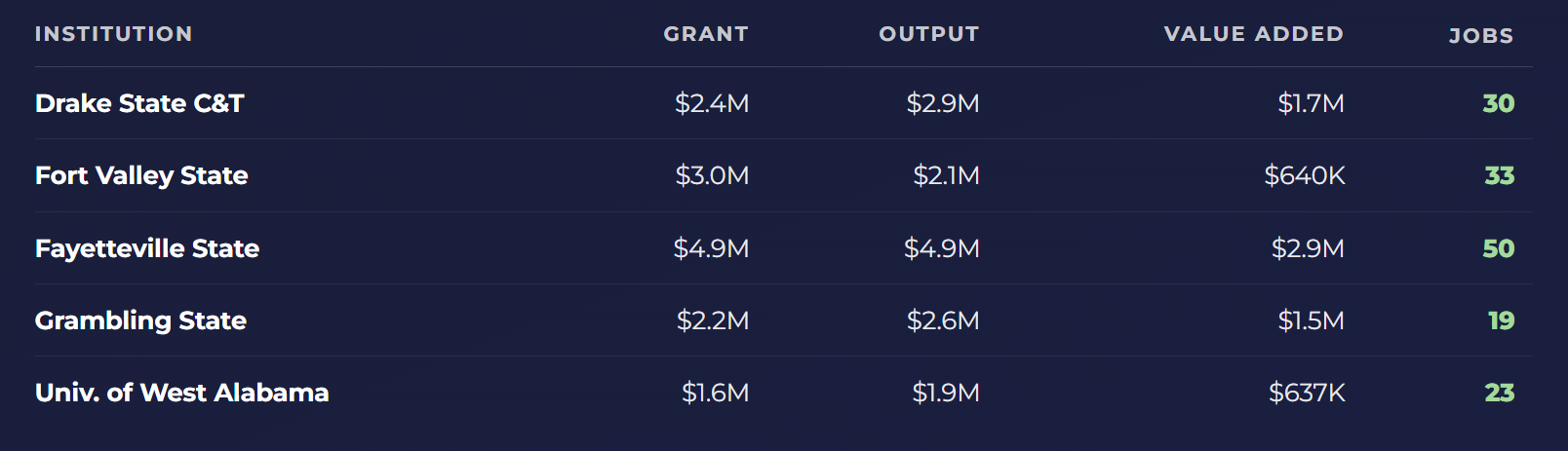
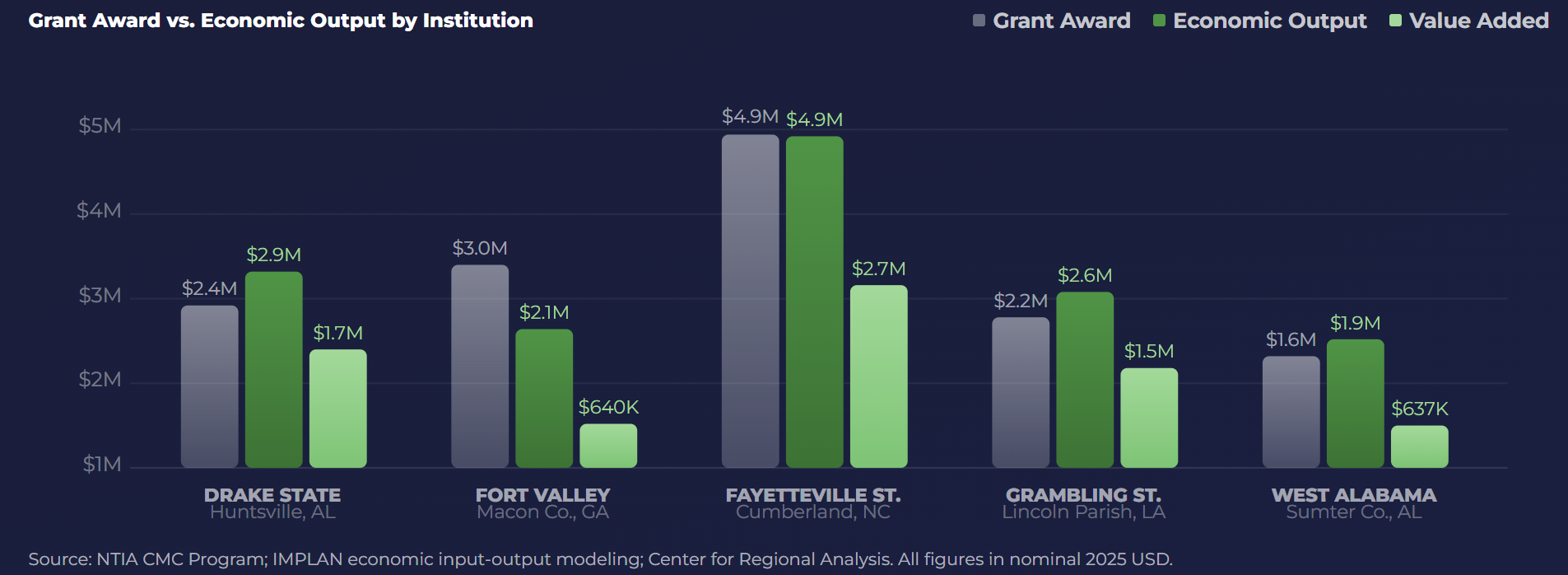
$1.01 in economic activity per grant dollar. That's a modest early return, but it comes from communities that have historically seen very little outside investment. These areas have fewer local businesses for spending to flow through, longer distances between people and services, and decades of underinvestment working against them. In that context, any return matters.
The bigger payoffs, including higher wages for credential completers, business revenue growth, and fewer costly ER visits due to telehealth access, will take more time to show up in the data. The real story of these investments is still being written.
Section 05: What Other Communities Can Take From This
If your community is thinking about broadband, read this first
We identified four conditions which together explain why these five programs worked, and why so many others don't. Remove any one of them and the other three lose most of their lasting power.
Installing internet was never enough. Training, devices, and the trusted people who helped neighbors actually use it: that's what these schools understood from day one.
HBCUs brought existing trust, existing relationships, and an existing reason to be there. Outside organizations starting from scratch would have taken years to build what these schools already had.
Mobile lab in Huntsville. Satellite in the Black Belt. Community summits in Macon County. No universal playbook: the approach must match actual conditions, not a grant template.
Co-designed device kits, community summits, navigators who were neighbors weren't just nice-to-haves. They were the reason people showed up, stayed engaged, and told their neighbors.
These five HBCUs showed that federal broadband investment can work when it's channeled through trusted institutions and designed around local conditions, not national templates.
As programs like BEAD roll out billions in new broadband spending, the risk is that efficiency and standardization will crowd out the local adaptability that made the CMC model work.
The question isn't whether to invest in broadband. It's whether future programs will leave enough room for local institutions to do what they do best.
Download the Paper
Everything on this page comes from a single, comprehensive paper.
The full methodology, data tables, HBCU case studies, and policy recommendations — all in one document. Free to read, free to share.