<< Our Broadband Work 

5 Ways to Spend $21B: The Fight for BEAD Non-Deployment Funds

Analyzing NTIA Listening Sessions

As part of its request for stakeholder input regarding potential BEAD program savings, NTIA conducted listening sessions on February 11, 2026, and February 18, 2026

This following deck, produced by Kaptivate, provides a structured synthesis of stakeholder perspectives expressed during those NTIA listening sessions, with a particular emphasis on potential uses for BEAD program funds not allocated to deployment. We also thank the Benton Institute for Broadband and Society for capturing content from the listening sessions, which supported the development of the transcripts used in this analysis

For additional context on evolving BEAD policy and implementation trends, see Kaptivate’s related analysis: Blurring BEAD: How the Push for Deployment is Erasing the Path to Adoption
Disclaimer

This document summarizes themes and viewpoints expressed during the recorded NTIA listening sessions. The analysis is based solely on statements from those sessions; no written testimonials, submitted comments, or external materials were included. All quotations are drawn directly from recordings and transcripts, with speakers anonymized to preserve privacy and emphasize the substance of the discussion. This document represents a neutral synthesis of participant testimony and does not reflect policy positions, recommendations, or opinions of Kaptivate. 

1-4
2-Mar-04-2026-07-47-39-8400-PM
3-2
4-2
5-1
6-1
7
8-2
9-1
10
11-1
12

Want to explore more?

Check out the visualizations below for a deeper dive

Thematic Analysis

Thematic analysis groups stakeholder comments into recurring policy topics discussed during the NTIA listening sessions. Rather than focusing on individual speakers, this approach identifies patterns in how participants frame broadband policy and reveals which issues dominate the discussion.

Thematic heirarchy

Participants consistently framed broadband not simply as telecommunications infrastructure, but as a foundation for economic participation, public services, and national competitiveness. Many speakers emphasized that BEAD represents a “once-in-a-generation opportunity” to build digital infrastructure that will shape economic participation for decades. 

This sunburst chart organizes the discussion from broad policy themes at the center to more specific issues on the outer rings. Larger segments indicate topics that appeared more frequently in stakeholder comments. The visualization shows that participants most often connected BEAD implementation with digital adoption programs, infrastructure deployment challenges, and workforce considerations, illustrating how stakeholders frame broadband policy as a combination of technical and social challenges.

To explore the hierarchy, click on any segment to zoom into that topic and view its subtopics in more detail; click again in the center to zoom back out. 


Sentiment

Sentiment analysis examines the tone of comments associated with different topics, identifying where participants expressed strong support, concern, or disagreement. This helps highlight which policy areas generate consensus and which ones involve more complex tradeoffs.

Most positive and negative topics

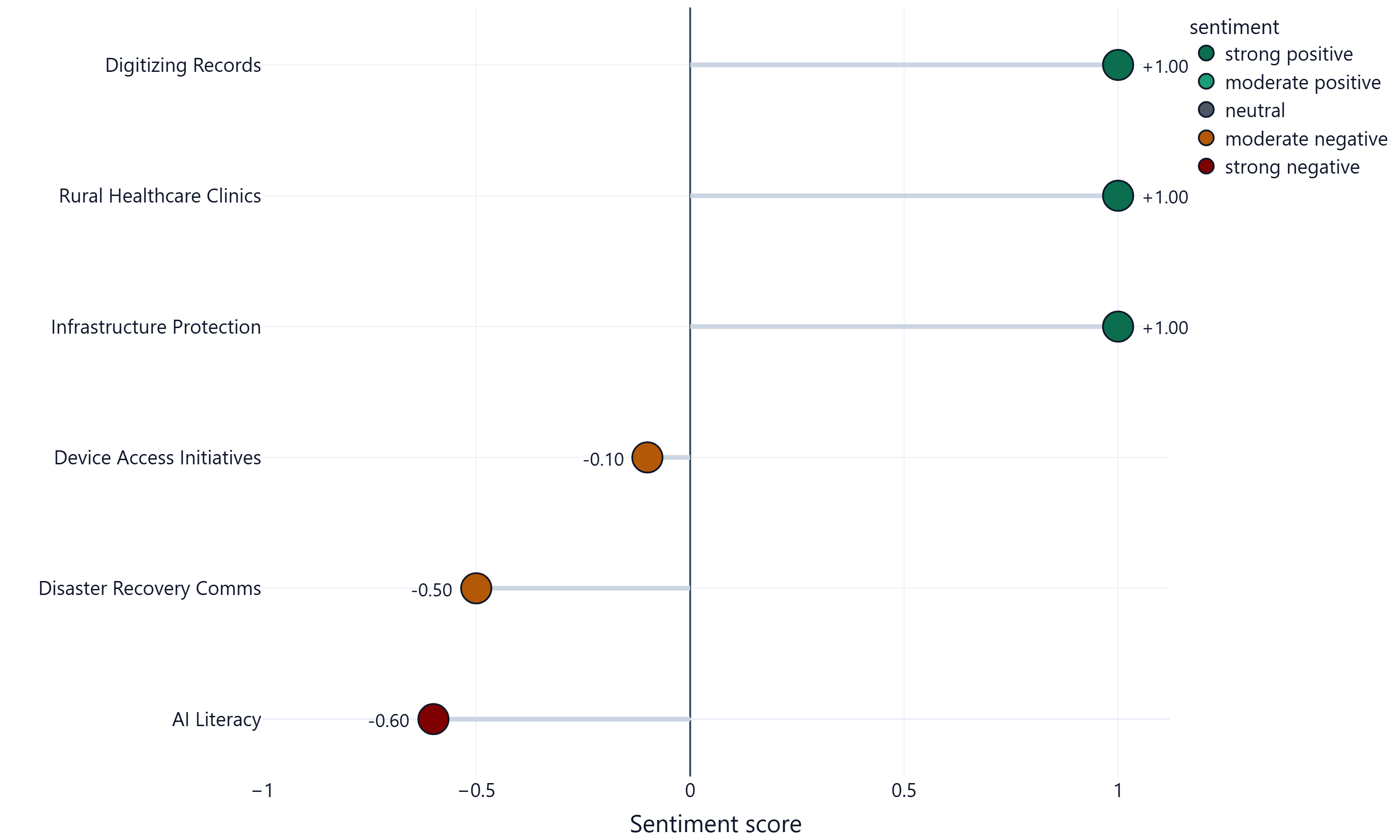
This chart highlights the topics associated with the strongest positive and negative sentiment across stakeholder comments. Bars extending to the right indicate more positive sentiment, while those extending left reflect more critical or concern-oriented discussions.

Topics such as digitizing records, rural healthcare connectivity, and infrastructure protection received the most positive sentiment. 

More negative sentiment appears around AI literacy, disaster recovery communications, and device access initiatives. In these cases, negative tone often reflects uncertainty about implementation or questions about whether these initiatives should fall within the scope of broadband infrastructure funding.

Hover over any dot for more detailed information.

Top 3 Positive and Negative Topics

Most contentious topics

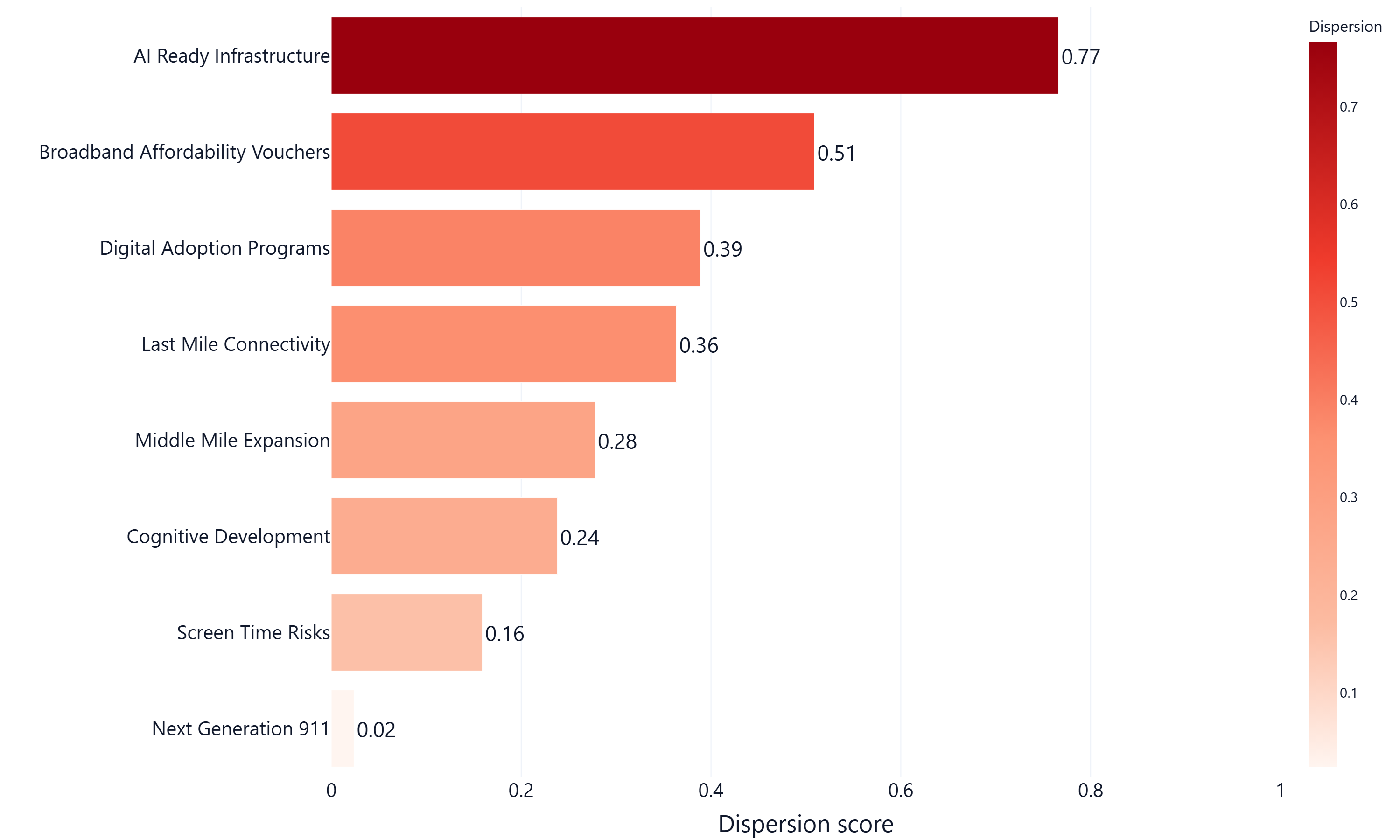
This chart identifies topics where stakeholder opinions diverged most strongly. Darker bars represent greater dispersion in sentiment, meaning participants expressed a wider range of perspectives.

Priorities, such as AI readiness, affordability vouchers, or digital adoption programs, show the highest disagreement levels. While some stakeholders see these initiatives as necessary complements to broadband deployment, others worry that they divert resources from core infrastructure investments.

Hover over any bar for more detailed information.

Most Contentious Topics

Emotional Tone

Emotional tone analysis looks beyond positive or negative sentiment to identify the types of emotions expressed in stakeholder comments. This provides insight into how participants frame the urgency and significance of broadband policy decisions.

Emotional tone share

This chart shows the overall emotional distribution across the discussion.

By far the dominant emotional tone in the discussion is urgency. Many participants framed broadband implementation as a time-sensitive opportunity that, if delayed or poorly executed, puts communities at risk of remaining disconnected for generations.

Speakers frequently described broadband as essential for economic survival, education access, and healthcare delivery, particularly in rural communities.

Hover over any slice for more detailed information.


Emotion by stakeholder group

This visualization shows which stakeholder groups contributed most to each emotional tone.

Government agencies and regional planning organizations contributed many of the urgency-driven comments, often emphasizing implementation deadlines and the need to deploy funds quickly. Meanwhile, ISPs and digital inclusion groups more frequently expressed fear and anxiety about whether infrastructure investments would translate into meaningful access for underserved populations.

These differences reflect the distinct roles stakeholders play in broadband policy: some focus on deploying networks, while others focus on ensuring communities can use them.

Click on any square to zoom into that emotion or stakeholder group in more detail; click again to zoom back out.


Conclusion

The NTIA listening sessions highlight the complexity of the next phase of broadband policy. While infrastructure deployment remains central, stakeholder comments reveal a broader understanding of connectivity as an ecosystem that includes digital adoption, workforce development, community institutions, and emerging technologies.

For many stakeholders, this investment is not simply about expanding network coverage, it is about shaping how communities participate in the digital economy, access healthcare and education, and compete in an increasingly connected world.

The strong sense of urgency throughout the discussion reflects the scale of the opportunity. The BEAD program represents a $42.45 billion federal investment to connect every American to reliable high-speed internet and decisions about the roughly $21 billion in non-deployment funding therefore carry significant implications for whether that mission can be fully realized.

For a deeper exploration of how BEAD policy has evolved, including regulatory changes, funding strategies, and the long-term implications of federal broadband investment, see our broader analysis:

Blurring BEAD: How the Push for Deployment is Erasing the Path to Adoption

Questions?

Contact Our Broadband Team

If you have questions about this analysis or would like to discuss the implications of evolving BEAD policy, our broadband team would be happy to connect. Kaptivate works with government agencies, industry partners, and community organizations to analyze broadband programs, evaluate funding strategies, and support data-driven connectivity initiatives.

For inquiries related to this analysis or to explore collaboration opportunities, please contact our broadband team at:

sharmon@kaptivategroup.com

We welcome conversations with policymakers, researchers, and organizations working to expand broadband access and strengthen digital participation across communities.